



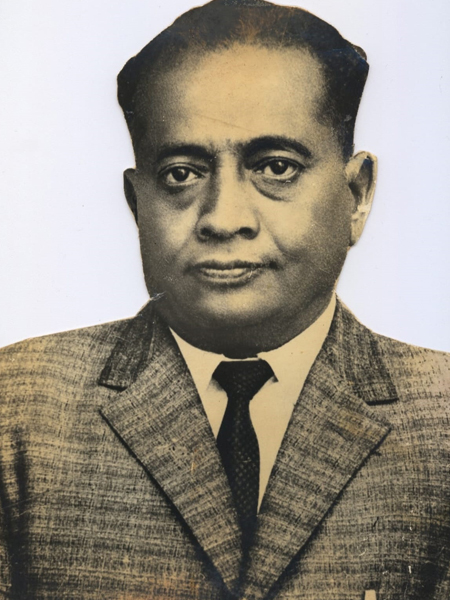
DR. R. SUBRAHMANYAM: A DISTINGUISHED HISTORIAN AND ARCHAEOLOGIST
DR. R. SUBRAHMANYAM: A DISTINGUISHED HISTORIAN AND ARCHAEOLOGIST
The premature and sudden demise of Dr. Raviprolu Subrahmanyam on 30th Nov 1981 has created a Great void which remained unfilled. He towers over the 20th century Archaeology of Andhra Pradesh, like a Colossus
Born in Pallipadu, village of Nellore District on 8.2.1923 in an orthodox Brahmin family, he had his early education in the local schools and V. R. High School and College of Nellore. He joined the Andhra University in 1942 and took his B.A. Honors’ in History in the year 1945 under Prof. Gurti Venkata Rao and Shri Mallampalli Somasekhara Sarma. At the age of 25, he became the second to be awarded the Ph.D., from the History Department, the first being Dr. O. Ramachandraiya. His dissertation, “The Suryavamsi Gajapatis of Orissa” was later published by Andhra University (1957). This was hailed as a work of great acumen and originality for a young scholar of his age. Sooner he joined a course in Field Archaeology under the British Archaeologist, Sir Mortimer Wheeler at Arikamedu and later in 1946 at Harappa along with the other prominent researchers of the time like Dr. O. Ramchandraiya, Late Drs. Bedapudi Subbaroa and M Seshadri, Drs. N. R Banerjee, R.C. Aggarwal, Profs. G. R. Sharma, B.B. Lal, N.Isaac, Sarvashri B. K. Thapar and T. Khazanchi. Many had a great liking for him, his company, his talk, his driving energy imbibed from his field master, the famed Sir Mortimer Wheeler, of the Harappa Arikamedu Excavations.
He had great power of imagination, planning and spirit of adventure, that were ideal for directing a large scale excavation as at Nagarjunakonda ( 1954-60) , first and only one of its kind in India accomplished so very well. He got Laurels for this work from no less a patriot and ardent lover on India’s culture and of Nagarjunakonda in particular, Pandit Jawaharlal Nehru, the then Prime Minister of India and Sri Rajendra Prasad, the first President of India. Dr. R. Subrahmanyam, the Doragaru as he was affectionately called, headed a group of expert excavators, supervised a small army of workmen and students at Nagarjunakonda and more recently at the Srisailam sites. His best known digs were Hampi (1947), Salihundam (1953), Nagarjunakonda (1954-60) and Amaravati (1958). These are classics of archaeological excavations in the country. Like his Guru Sir Wheeler, Dr Subrahmanyam trained dozens of students and carried out a series of excavations (a senior officer of the Archaeological Survey of India), between 1948 and 1964. His stepping into the University chairs i.e., Osmania , the post graduate centre of the Andhra University, Guntur which later became the Nagarjuna University has virtually cut him off from the mainstream of energy packed adventurist- Archaeology. He suffered inwardly at the lack luster company of just born departments of Ancient Indian History, Archaeology and Culture at these institutions. But he made headway in making them sound and organized them to a large extent. His sudden demise caused dismay to one and all.
He was the center of attraction in any company, encouraging, listening, gossiping, laughing and above all caring for the young, who were working far from their familiar sites. He lit the light in several dark homes. His love for company, his hospitality at home, to both friends and relatives alike was too well known. God has bestowed him, jealousy indeed, seven sons and one daughter, all distinguished themselves in studies and settled well in professions, in a manner worthy of their father’s intellect and good heart. This man had a charming life, always looking forward, a friend and mentor, indeed a leader of people. His sound advice on being a good historian and archaeologist is still with me and it was he who pursued youngsters like me with a command—“Do it, you will know how much more you have to learn”. He was generous and kind to the needy. I know of several young scholars benefitted by his writings. He never bothered to own his writings. Dr. R. Subrahmanyam, was a man of bewilderingly rich ideas and anecdotes, a sought after man enjoying himself and rejoicing others. He was well aware of his own imperfections. His varied career in several other spheres was not so happy and beset with official insecurities.
There were flashes of brilliance and charm, his ready- wit and warmth made him a leader in academic disputations, by the Indian History congresses, the all India Oriental Conferences, the Numismatic Society of India, epigraphical Society and the Archaeological Society of India, or his own child, the Andhra Pradesh History congress. He steered the Andhra Pradesh History Congress for six years. Dr. R.Subrahmanyam was the founder- member , working president, sectional president( 1st Session), General President( 2nd Session) , Sectional President( 3rd Session), Vice Chairman ( 4th Session), Local Secretary( 5th Session) and what not? In Short, he was the whole and soul of the A.P.H.C. His was a colourful, dynamic and creative personality. He had always been a pillar of strength to the young and old alike, groomed scores of working Archaeologists and Historians. He was the most ardent lover of Andhra history, epigraphy and archaeology and made everlasting contributions to its various facets. He was held in great affection and esteem and virtually a “Dr Sankalia” of the South. His presence in the various conferences, both National and International, had an electrifying effect and earned special place for the history and Archaeology of A.P. To the A.P. History congress, his absence is something unbearable. To me, in particular, being a humble student of his, hailing from his own place and tasted fully his great affection, for nearly two and half decades his sudden demise made me rudderless.
After Independence, no other part of India has perhaps received greater attention in archaeological matters than A.P and the entire credit for this would go to the three stalwarts mentioned above, more specifically, the late lamented Dr. R. Subrahmanyam who was the real ”Arjuna” in the field. It was A. Ghosh who vested upon Dr. Subrahmanyam in the year 1954 the gigantic task of salvaging the vast Nagarjunakonda treasures.
This was a stupendous venture and a challenging task taken up Dr. R. Subrahmanyam, the then charming young and dynamic scholar trained by Sir. Mortimer Wheeler. He succeeded tremendously in unearthing the heritage of Nagarjunakonda in a record time of six years (1954-60) on a much bigger scale than Sir John Marshall’s Taxila- Sirkap. As witness to the foresight and planning of Ghosh- R.S combination, two central museums got established in Andhra Pradesh, the first one, over the hill called Nagarjunakonda, a unique example of an island museum and foremost of its kind in the world; the other at Amaravati, a site museum, unparalleled with this sculptural relics unearthed from this world renowned ancient art centre of India. Nagarjunakonda and Amaravati were the first loves of R. Subrahmanyam and he toiled to keep them voluptuously in various International and national academic meets.
It was Dr. R. Subrahmanyam, who spearheaded the research on Andhra Epigraphy on an unprecedented scale taking the queue from the doyens like Sri Venugopala chetty, Butterworth, Rao Bahadur Venkayya, Krishna Sastry, C.R. Krishnamacharyulu, Mallampalli Somasekhara Sarma and Nelaturi Venkataramanayya, all renowned epigraphists from Andhra. There was another scholar friend of considerable stature and resources like Dr. N. Ramesan to follow him. Andhra Pradesh lost these two great sons within a month in quick succession in November, 1981.
It was mostly due to the efforts of Dr. Subrahmanyam that Andhras come to be known to the Buddhist Study Centers at Tokyo, Ceylon, Tibet, Bhutan, Sikkim and America where from, scholars come to Andhra to work on art and Architecture or linguistics and folklore every year. It was the contribution of Dr. R. Subrahmanyam under the stewardship of Dr. N. Venkataramanayya that today we could boast of so many up to-date district wise corpuses of inscriptions, numismatic catalogues, special monographs, works on architecture, art and epigraphy of Andhra. D. Subrahmanyam was indeed a Karma yogi for till the last minute of his sad demise, he toiled with total dedication on the transplantation works of the submersible temples coming under the Sri Sailam hydro- Electric Dam and towards the establishments of Buddhist Study Centers at Amaravati and Nagarjunakonda.
A large number of elders, friends and students of late Dr. R. Subrahmanyam decided to open a Research centre named after him mainly to promote a systematic study and higher research in Indian History, culture and Archaeology, subject dear to the departed scholar. The sons and heirs of Dr. Subrahmanyam have spontaneously gifted the rich library and other collections of their revered father. A charitable trust named Raviprolu Subrahmanyam Research Center (RSRC) was registered at Guntur during the month of June 1982 to perpetuate the memory of this distinguished Archaeologist- Historian.